
Karela
Momordica charantia • English: Bitter Melon / Bitter GourdThis distinctive bitter fruit is valued as both a nutritious food and a traditional botanical. Modern research has explored it particularly in relation to glucose metabolism, while clinical evidence remains mixed.
Herb Pharmacopoeia Monograph
The Distinctive World of Karela
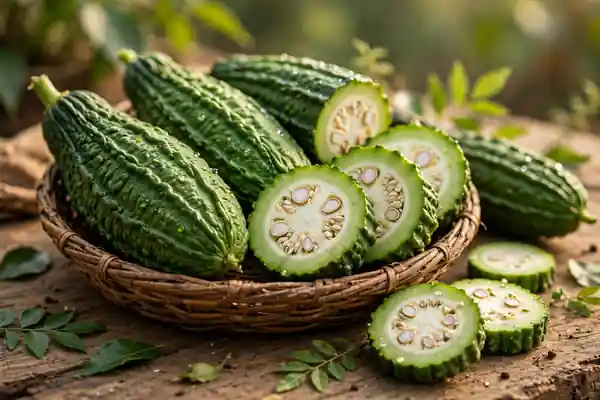
Karela (Momordica charantia) is a tropical vine in the cucumber and melon family. Its immature fruit is widely used as a vegetable, while its bitterness comes from a complex mixture of plant constituents.
VAIDAI distinguishes the fruit’s role as food, traditional herbal use and concentrated extract. Human research has investigated glucose-related outcomes, but systematic reviews do not agree on a clear overall clinical effect.
7 Powerful Karela Benefits & Wellness Associations
Evidence-informed ways to understand Karela without overstating current research.
Glucose Metabolism Research
Human studies have explored Momordica charantia for glucose-related outcomes.
Findings are mixed across systematic reviews and clinical trials.
Traditional Metabolic Wellness
This bitter botanical has a long history as a food in South Asian traditions.
Traditional use does not by itself establish a medical treatment effect.
Bitter Digestive Profile
Its distinctive bitter taste is central to the fruit’s culinary and traditional identity.
Fresh cooked fruit is different from concentrated herbal extracts.
Plant Phytochemicals
The fruit contains diverse plant metabolites studied in laboratory and nutritional research.
Laboratory findings cannot automatically be translated into human benefits.
Dietary Variety
As a vegetable, bitter gourd can add variety to a plant-forward diet.
Food use should be distinguished from supplement use.
Preparation Diversity
Fruit, juice, dried material and extracts can have different chemical profiles.
Dose and preparation can materially change exposure.
Growing Scientific Interest
Recent trials continue to study this botanical in prediabetes and type 2 diabetes research.
Larger, longer and better-standardized trials are still needed.
Karela in Traditional Herbal Practice
This botanical is best understood as a traditional food and bitter botanical rather than a single standardized medicinal product.
Food, Bitterness & Tradition
Across South Asian traditions, bitter gourd has been valued as a vegetable and included in household preparations. Traditional interpretations often associate bitter foods with digestive and metabolic balance.
Traditional use is culturally important, but it should not be presented as proof that the plant treats a disease.
Preparation Diversity
Fresh fruit, cooked preparations, juice, dried material and extracts can differ in concentration and chemistry.
Plant part, maturity, extraction method and dose all matter when interpreting research.
Karela's Bioactive Chemistry
The fruit contains a diverse mixture of plant metabolites rather than one single active ingredient.
| Compound / Group | Plant Part | Research Context |
|---|---|---|
| Cucurbitane-type triterpenoids | Fruit and tissues | Investigated for diverse biological activities in preclinical research. |
| Charantin-associated constituents | Fruit | Frequently discussed in research on the fruit’s glucose-related activity. |
| Flavonoids & phenolic compounds | Various parts | Associated with antioxidant activity in laboratory studies. |
| Proteins & peptides | Fruit and seeds | Investigated for possible metabolic interactions. |
Modern Scientific Research
Human research on this botanical is active, but findings are not uniform.
| Research | Focus | Finding | Evidence Note |
|---|---|---|---|
| 2018 systematic review & meta-analysis | Prediabetes / T2D | Reported reductions in fasting glucose, post-meal glucose and HbA1c in included studies. | Evidence quality was downgraded because of limitations and small studies. |
| 2024 systematic review & meta-analysis | Metabolic outcomes | No significant overall effect for several outcomes compared with placebo. | Trials were small, short and heterogeneous. |
| 2025 randomized trials | Prediabetes | Selected glucose-homeostasis markers improved in some analyses. | Effects were not uniform across all outcomes. |
| 2020 randomized trial | Type 2 diabetes | Fasting glucose decreased, while HbA1c did not differ from placebo. | Short-term evidence; not proof of disease treatment. |
Ways Karela Is Commonly Prepared
Preparation and concentration matter. Follow product directions for herbal preparations.
Fresh immature fruit is commonly cooked as a vegetable and is different from concentrated extracts.
Fresh juice is used in some traditional practices, but its concentrated nature warrants thoughtful use.
Dried fruit or powder may be used traditionally. There is no universal dose for every product.
Extracts can concentrate plant constituents. People taking glucose-lowering medicines should seek professional advice before use.
Safety Considerations & Contraindications
The whole fruit is commonly eaten as food, but concentrated preparations deserve additional caution.
- Blood glucose: Concentrated preparations may influence glucose levels. People using insulin or glucose-lowering medicines should seek professional advice.
- Pregnancy: Avoid medicinal or concentrated preparations during pregnancy unless specifically advised by a qualified professional.
- Children: Concentrated extracts and medicinal doses should not be given to children without appropriate guidance.
- Digestive effects: Juice, powders or extracts may cause gastrointestinal discomfort in some people.
- Preparation matters: Food, juice, dried powder and extracts are not interchangeable.
- Medical care: This botanical should not replace prescribed medicines, monitoring or professional treatment.
Frequently Asked Questions
Clear answers about this botanical, traditional use, research and safety.
Bitter melon or bitter gourd is Momordica charantia, a tropical vine in the Cucurbitaceae family used as a food and in traditional herbal practices.
The botanical name is Momordica charantia L., a member of the Cucurbitaceae family.
It has traditionally been used as a bitter vegetable and in household herbal preparations, especially in contexts associated with digestion and metabolic wellness.
Yes. Human studies have investigated Momordica charantia and glucose metabolism, but results are inconsistent and depend on preparation, dose and study design.
No. It should not replace prescribed medicines, glucose monitoring, diet or professional medical care.
It contains cucurbitane-type triterpenoids, flavonoids, phenolic compounds and other plant metabolites; composition varies by plant part and preparation.
It is commonly eaten cooked as a vegetable. Traditional preparations can also include juice, dried material and extracts.
It may influence glucose levels in some settings. People taking glucose-lowering medicines should seek professional advice and monitor appropriately.
Concentrated medicinal preparations should be avoided during pregnancy unless specifically advised by a qualified healthcare professional.
Whole bitter gourd is a food, while extracts can concentrate particular constituents. Evidence and safety cannot automatically be transferred from one form to another.


Selected Research References
- Peter et al. Systematic review and meta-analysis of Momordica charantia in elevated glycaemia.
- Laczkó-Zöld et al. The metabolic effect of Momordica charantia cannot be determined based on available clinical evidence.
- Mes et al. Bitter gourd supplementation for twelve weeks improves biomarkers of glucose homeostasis in prediabetes.
- Hahm et al. Hypoglycemic efficacy and safety of Momordica charantia in type 2 diabetes.
- Kim et al. Momordica charantia efficacy and safety in Korean prediabetes participants.