
Ashwagandha
Withania somnifera • English: Ashwagandha / Indian GinsengThis traditional Ayurvedic botanical is valued for its long history in restorative and rasayana-oriented wellness practices. Modern research has investigated standardized Ashwagandha preparations particularly in relation to stress, anxiety and sleep, while evidence remains dependent on the extract, dose and study design.
Herb Pharmacopoeia Monograph
The Botanical Story
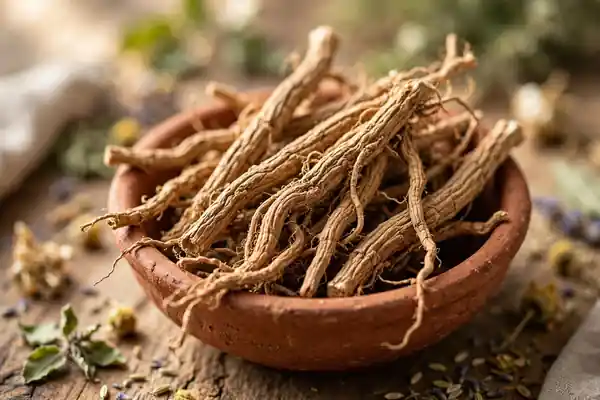
Ashwagandha (Withania somnifera) is a botanical with a long history in Ayurveda. The root has traditionally been used in restorative and rasayana-oriented preparations, while different plant parts and extracts can have different chemical profiles.
VAIDAI presents this herb with a clear distinction between traditional knowledge, food-level or customary herbal use, and concentrated supplements. Modern human studies have mainly examined standardized or defined extracts for stress, anxiety and sleep-related outcomes.
Wellness Areas Studied
A careful overview of traditional associations and the areas explored in human research.
Stress & Adaptogenic Tradition
This herb is traditionally associated with resilience and restorative wellness, and modern trials have explored perceived stress and stress-related measures.
Ayurvedic traditions describe this botanical in restorative and rasayana contexts.
Systematic reviews and randomized trials report promising effects on stress measures, although study heterogeneity remains important.
Sleep & Restful Routine
Ashwagandha has been investigated for sleep quality and selected sleep parameters in adults.
A systematic review of five randomized trials found a small overall improvement in sleep, with stronger effects in some insomnia and higher-dose subgroups.
Results relate to specific extracts and study protocols and should not be generalized to every product made from this botanical.
Anxiety & Emotional Wellness
Human research has explored Ashwagandha in adults reporting stress or anxiety symptoms.
Recent systematic reviews report reductions in some anxiety measures, but evidence quality and consistency vary across trials.
Promising research does not establish this herb as a treatment replacement for diagnosed anxiety disorders.
Traditional Restorative Use
Ashwagandha has a long-standing place in Ayurvedic herbal practice, particularly in rejuvenative and strength-supporting traditions.
Classical use provides cultural and historical context but should not be presented as proof of modern clinical efficacy.
Contemporary research is increasingly focused on defined root extracts and measurable outcomes.
Root-Based Preparations
The root is the principal part used in many traditional preparations and contemporary supplements.
Root powder and standardized extracts can differ greatly in concentration and phytochemical profile.
Product identity, extraction method, standardization and testing influence how research findings should be interpreted.
Withanolide Chemistry
Withanolides are among the characteristic steroidal lactones that make this botanical a subject of phytochemical research.
Withanolides and related compounds vary with plant part, cultivar, extraction process and standardization.
A named compound or laboratory finding alone does not establish a clinical benefit in humans.
The Herb in Ayurveda
A traditional perspective, presented separately from modern clinical evidence.
Rasayana Tradition
In Ayurveda, Ashwagandha is widely recognized as a rasayana-oriented botanical and has traditionally been used in formulations associated with nourishment, strength and restorative care.
Traditional classifications and indications belong to a historical medical system and should not be interpreted as direct proof of modern disease treatment.
Traditional Context
Plant Part
The Ashwagandha root is the most familiar part in many traditional and modern preparations.
Restorative Use
Traditional practice places this botanical within broader restorative and rasayana routines.
Preparation Awareness
Root powder, decoctions and concentrated extracts are different preparations and should not be treated as interchangeable.
Bioactive Chemistry
The compounds and preparation factors that shape the botanical profile of this botanical.
Withanolides
Characteristic Steroidal Lactones
Withanolides are a major group of steroidal lactones associated with Withania somnifera and are commonly used as markers in standardized extracts.
Withaferin A
A Widely Studied Constituent
Withaferin A is one of the best-known withanolides. Its biological activity is widely studied, but laboratory findings should not be equated with proven clinical benefits.
Alkaloids & Other Constituents
Broader Phytochemical Matrix
Ashwagandha contains additional alkaloids and phytochemicals. Their relative amounts vary with plant material, cultivation and extraction.
Standardization Matters
Extract-Specific Chemistry
Different commercial extracts can have different withanolide profiles and concentrations. Research results should therefore be matched to the type of extract studied.
Modern Scientific Research
A concise synthesis of peer-reviewed human research on preparations of this herb.
| Research Area | Preparation / Population | What the Research Suggests | Evidence View |
|---|---|---|---|
| Stress & Anxiety | Oral Ashwagandha extracts in adults | Systematic reviews of randomized trials report reductions in some perceived stress and anxiety measures compared with placebo, but heterogeneity and evidence certainty remain important limitations. | Promising / Developing |
| Sleep | Extracts in adults, including some with insomnia | A systematic review of five randomized trials found a small overall improvement in sleep, with some stronger effects in selected subgroups. | Promising / Limited |
| Long-Term Use | Varied commercial and research extracts | Many trials are short and use specific standardized products. More robust long-term safety and effectiveness data are needed before broad conclusions can be made. | Insufficient for Broad Claims |
| Safety & Tolerability | Root extracts in clinical studies | Short-term studies often report good tolerability, but adverse effects can occur and rare cases of clinically significant liver injury have been reported in the literature. | Use With Caution |
Preparation & Traditional Forms
Different Ashwagandha forms should be considered separately because concentration and composition can vary.
Root powder is a traditional form. Use only food- or supplement-grade material from a reputable source and follow the product's directions.
Traditional preparations vary by formula and practice. Preparation instructions should come from a qualified Ayurvedic practitioner or the specific product label.
Clinical studies often use defined extracts rather than ordinary root powder. Do not assume the dose used in one study applies to every commercial extract.
Products containing multiple botanicals require additional attention to ingredient interactions, extract strength and individual suitability.
Safety Considerations & Contraindications
Ashwagandha is not risk-free. The safety profile depends on the preparation, dose, duration and individual health context:
- Pregnancy: Ashwagandha supplements are generally best avoided during pregnancy unless a qualified clinician specifically recommends otherwise.
- Liver Health: Rare cases of liver injury have been reported with Ashwagandha products. People with liver disease should avoid self-directed use and seek professional advice.
- Thyroid & Autoimmune Conditions: This botanical may influence thyroid-related measures and immune activity; people with thyroid or autoimmune conditions should consult a qualified professional before using concentrated supplements.
- Sedating Medicines: Because this herb may cause drowsiness in some people, caution is appropriate with sedatives or other medicines that cause sleepiness.
- Gastrointestinal Effects: Some users may experience stomach upset, nausea, loose stools or other digestive discomfort.
- Children: Concentrated supplements containing this herb should not be routinely given to children without age-appropriate professional guidance.
- Preparation Difference: Root powder, decoctions, standardized extracts and combination formulas can differ substantially in dose and chemistry.
Frequently Asked Questions
Clear answers regarding this herb, traditional use, preparations, research and safety.
Ashwagandha is Withania somnifera, a botanical traditionally used in Ayurveda. The Ashwagandha root is the most familiar part in many traditional and modern preparations.
The botanical name is Withania somnifera, a member of the Solanaceae family.
Withanolides and related steroidal lactones are among the characteristic phytochemicals of this botanical. Their levels vary by plant part and extract.
In Ayurveda, this botanical has a long history of use in restorative and rasayana-oriented herbal practices. Traditional use should not be presented as proof of modern medical efficacy.
Yes. Human research has examined extracts of this herb particularly for stress, anxiety and sleep. Results are promising in some reviews but vary by product, dose and study quality.
Several randomized trials and systematic reviews report improvements in stress-related measures, but evidence is still developing and does not establish this herb as a replacement for professional treatment.
Some randomized trials and a systematic review found modest improvements in sleep measures in adults. The findings apply to studied extracts and cannot automatically be generalized to all products.
No. Many short-term studies report good tolerability, but side effects can occur and rare cases of liver injury have been reported. Concentrated supplements deserve more caution than ordinary culinary herbs.
Pregnant people should generally avoid concentrated supplements containing this herb unless specifically advised by a qualified clinician. Extra caution is appropriate with liver disease, thyroid disorders, autoimmune conditions and medicines that may interact.
No. Root powder, decoctions and standardized extracts can differ substantially in concentration and composition. Research findings should be interpreted according to the exact preparation studied.
Related Ayurvedic Herbs
Discover complementary botanicals within the wider VAIDAI Herb Library.
Academic & Scientific References
- 1. PubMed: Effects of Withania somnifera on stress and anxiety — systematic review and meta-analysis (2024).
- 2. PubMed: Effect of Withania somnifera extract on sleep — systematic review and meta-analysis (2021).
- 3. PubMed: Safety and efficacy of Withania somnifera for anxiety and insomnia — systematic review and meta-analysis (2024).
- 4. PubMed: Withania somnifera-associated liver injury — scoping review of clinical safety reports (2026).
- 5. PubMed: Safety and clinical effectiveness of Withania somnifera root in human ailments — review of human studies.
- 6. VAIDAI Herb Library. Educational botanical interpretation based on traditional use and modern research literature.
Disclaimer: This information is intended strictly for educational and informational purposes only and is not a substitute for professional medical advice, diagnosis, or treatment. Always consult with a qualified healthcare provider or certified Ayurvedic practitioner before introducing new herbal supplements to your regimen, particularly if you are pregnant, nursing, taking medication, or have a pre-existing medical condition.